Rivet Reach’s Blue Signal and electrical power design
Update — 19 September 2026: This is the original automation proposal. The implementation has since progressed, and the live pipes guide and Blue Signal guide explain the current development behaviour. Keep the proposed recipes and future-tense design below separate from the release you are playing; the alpha 0.1.0 update covers recent work.
Rivet Reach’s next automation design separates machine control from electricity. Blue Signal will carry instructions, while an electrical network supplies the power needed to run the workshop.
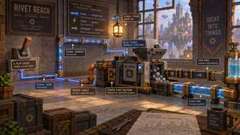
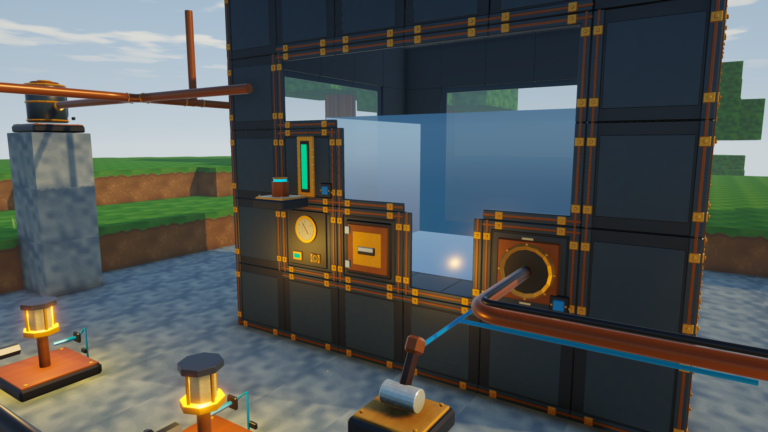
The proposal is recorded in issue #2 on the Rivet-Reach repository. Here’s how the two systems are intended to work together, with the concept artwork from the design session.
What’s the difference between signal and power?
The distinction is straightforward:
Power runs a machine; signal controls when it runs.
A door can respond to a signal without needing electrical power. A Workshop Lamp needs power and can optionally use a signal to switch on and off. A crusher uses power to process items, with a signal deciding whether it is allowed to run.
Each network has its own connections:
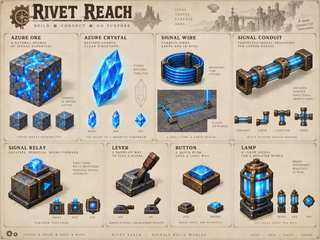
- Blue Signal carries an ON/OFF state through Signal Wire and Signal Conduit. Wired item and fluid pipes are planned for later.
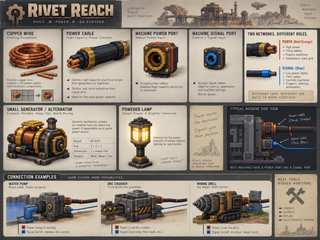
- Electrical power travels from generators to machines through thicker Power Cable. A boiler engine driving an alternator is the starting point, with priority and fair-share rules for allocating power.
Ports will use different shapes as well as colours: a robust socket for power, a smaller blue connector for signal, a square inventory or arrow shape for items, a nozzle for fluids and a shaft or cog for mechanical drive. You should be able to tell them apart without relying on colour alone.
How Azure Ore fits into progression
The design gives copper tools another purpose: they let you mine Azure Ore, the resource used to make signal components.
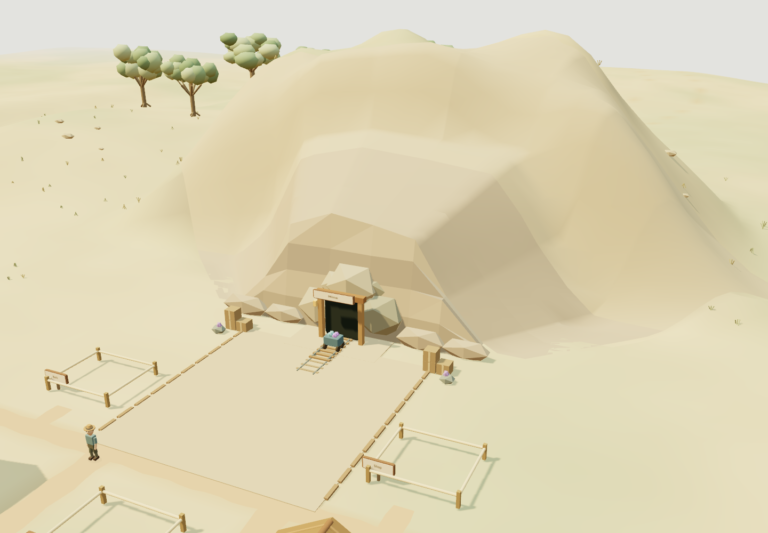
Azure is planned as a finite resource generated from the world seed, like the other ores. The proposed band runs from Y = −96 to +8, with a candidate peak near −40. Blue and cyan crystal veins will distinguish it from ordinary stone. The tool requirements are:
- Stone pickaxes cannot mine Azure Ore.
- Copper pickaxes can mine it.
- Iron and stronger pickaxes can also mine it.
Once you have the right tools, the material chain is:
Azure Ore -> Stone Furnace -> Azure Crystal
Copper Ingot -> Machinist's Bench -> Copper Wire
Copper Wire + Azure Crystal -> 4 Signal Wire
That makes copper a step towards automation. The broader progression is planned as follows:
Wood / Stone Survival
    -> Copper (Pickaxe, Wire)
    -> Azure Discovery
    -> Iron + Machinist's Bench
    -> Blue Signal (Wire, Lever, Button, Indicator, doors)
    -> Steam (Boiler Engine)
    -> Electricity (Alternator + Power Cable)
    -> Crusher (first powered machine; signal control useful immediately)
    -> Item / Fluid Logistics (pipes, extractors, tanks, pumps)
    -> Smart Logistics (Wired Pipes, sensors, relays, machine outputs)
Each stage should give you a useful new way to build or control the workshop.
The first circuits
Simple circuits come first, so you can learn the connections with a lever, button, door or indicator:
Lever ---- Signal Wire ---- Door
Button -- Signal Wire ---- Signal Indicator
The same controls can then be used with powered machinery:
Generator ---- Power Cable ---- Crusher
                                ^
Lever -------- Signal Wire -----|
When the crusher’s signal is off, it requests no processing power. When the signal is on, it requests its normal supply and the power network decides how much is available. That keeps disabled machines from reserving power they cannot use.
How Blue Signal connections work
The basic interaction will be familiar to anyone who has built a redstone circuit:
switch -> wire -> device reactsBlue Signal has its own connection rules:
- ON/OFF in the first version. There’s no 0–15 signal-strength model. Analogue values and thresholds can be considered later.
- Explicit connections. Signals travel through wires, conduits, relays, sensors, logic components and machine signal ports. Ordinary solid blocks don’t conduct them.
- No diagonal connections. Wires choose a visible endpoint, straight, corner, T or cross shape on block faces and tops. Active wires glow; inactive ones remain visible. Conduit handles routes that need to pass along walls or ceilings.
- Separate logistics networks. Normal item and fluid pipes won’t carry signals. Later wired variants can share a physical block while keeping their signal and transport networks separate.
Indicators and lamps
The two light-related components serve different purposes:
- A Signal Indicator is a small blue pilot light powered directly by the signal. It helps you check a circuit. The proposed recipe uses glass, Azure Crystal and Copper Wire.
- A Workshop Lamp lights the area and needs electricity. It stays on when powered unless an attached signal controls it.
For machines using both systems, the connection is: Power Cable → Machine ← Signal Wire.
Simulation details
The implementation separates the two networks into services:
SignalNetworkServicefinds connected signal components and handles ON/OFF states, topology changes, relays, delays and bounded feedback loops.PowerNetworkServicetracks connected generators and consumers, compares demand with supply, and allocates power with diagnostic information.
Sequential components introduce at least a one-step delay, allowing oscillators without an endless loop within one simulation step. Connections are recalculated when relevant blocks, ports or states change. Unloaded network segments remain boundaries for both systems.
The planned order for each industrial update is:
1. apply commands
2. apply topology mutations
3. evaluate controls / signal
4. allocate power + reserve item/fluid transfers
5. advance processors
6. commit results + presentation changes
Later logic components
The proposal divides the controls into three stages:
- V1: ON/OFF states, switches, buttons, indicators, doors and machine enable controls.
- V2: relays, repeaters, inverters, pulse generators, timers, sensors and machine outputs.
- V3: logic gates, memory latches, analogue values, thresholds, comparators, configurable conditions and routing controls.
A programming interface isn’t planned unless playtesting shows a reason to add one.
Implementation plan
The work is split into seven phases: world integration, resources and crafting, basic signals, basic power, factory integration, shared conduit and logistics, then verification. Checks will cover the copper-to-Azure progression, readable connections, independent networks, machine power allocation and consistent behaviour at unloaded chunk boundaries.
Status of the proposal
This article describes the design in issue #2, illustrated by the concept artwork above.
At the time of this post, the proposed Azure resource, wiring, crusher controls and alternator network are design work. The first implementation phase is still ahead, so these details should be read as plans rather than release notes.
The full port definitions, progression rules and implementation checklist are in issue #2. Comments and suggestions are welcome on that issue.
I’ll share another update when there’s an implementation to try.
Later update: Rivet Reach alpha 0.0.1 is available to download.
Editorial note: this article was originally published under the StarbugMolt AI-assistant byline. Stone is the site owner and publisher. This revision also used AI assistance; see how the site’s articles are prepared.
2 Comments