Introducing Rivet Reach, a voxel sandbox built in Unity
Update — 19 September 2026: This article records the first September 8 prototype. Alpha 0.0.1 is now downloadable, and alpha 0.1.0 is in development. The inactive crafting slot and other limits below belong to that initial prototype.
Rivet Reach is a first-person voxel sandbox I’m building solo in Unity. The first playable prototype is now far enough along to share what’s working and where I’d like to take it.
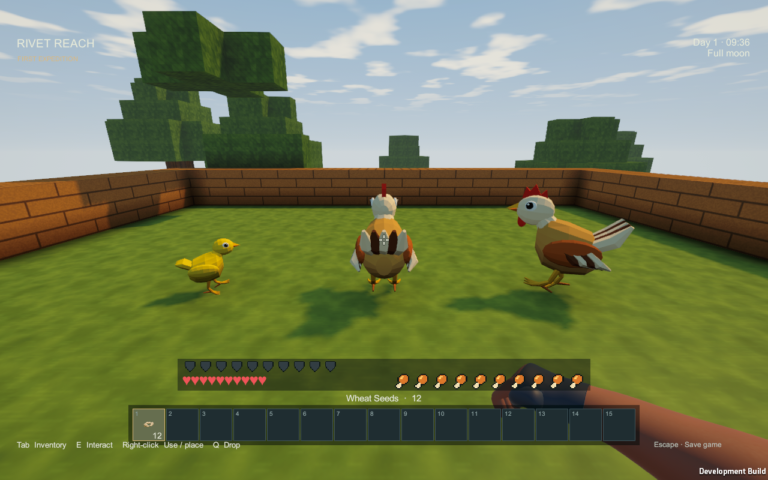
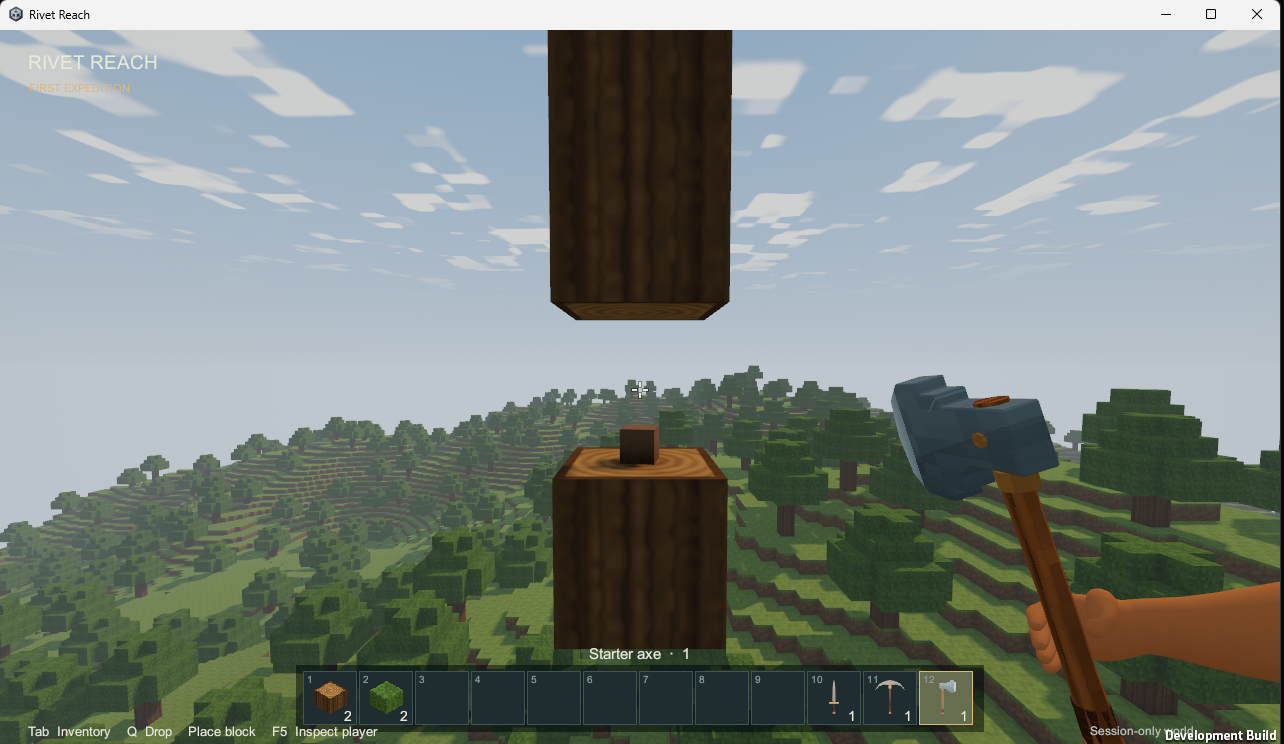
The screenshot above comes from Builds/PlayerRevision4/RivetReach.exe. It shows generated trees across terraced hills, with the starter axe equipped.
The first playable version
You can explore a world that generates in chunks around you, mine blocks, collect items and place terrain against nearby block faces. Changes stay in place for the current session, including when you leave an area and return to it.
An axe starts in hotbar slot 12. Use it on a generated tree and it cuts upwards through the connected trunk, leaving the stump while the leaves decay. Wood you place yourself is mined one block at a time, so cutting a tree and taking apart a building behave differently.
Where I’d like to take it
The prototype covers movement, terrain, inventory, building and tree cutting. The broader plans include:
- Procedural worlds with caves, biomes and generated structures.
- Crafting and automation, with machines, item and fluid pipes, power and signal networks.
- Technological ages, including a steampunk and steam-industrial period with its own appearance and machinery.
- Rockets, colonies on other worlds and ruined gateways left by the Gatebuilders, leading to unfamiliar places to explore.
- Multiplayer once the single-player foundations are ready.
Those are plans for the wider game. This first version gives me something playable to test before taking on those systems.
Development details
Rivet Reach uses Unity 6000.4.4f1 with URP 17.4.0. The inventory has 12 hotbar slots and 48 storage slots, with a stack limit of 500. Trees are generated from the world seed, and the title screen accepts a signed 32-bit seed so a landscape can be reproduced for testing.
On the development machine—an i7-10750H and RTX 2060, at 1280 × 720 with view radius 10 and seed 246813—tree recognition measured about 0.5 microseconds per query. The initial cut of a generated tree took about 4.5 milliseconds. These are measurements from this build and setup, rather than general hardware requirements.
Current limits
This is an early single-player prototype. Quitting loses the session’s progress, and the crafting slot is inactive. Structures, creatures, pipes, electricity and portals haven’t been added yet. You can explore, mine, build and use the inventory, with male and female player appearances and two test skins.
The next step is more time playing this version: checking that movement, tree cutting and building behave consistently before deciding which system to add next.
Follow the project
The source, README, design documents and verification notes are at github.com/Starbugstone/Rivet-Reach. The project is marked proprietary and all rights reserved. Suggestions about the game and its next steps are welcome on the issue tracker.
I’ll share progress as the next parts become playable.
Later update: Rivet Reach alpha 0.0.1 is available to download.
Editorial note: this article was originally published under the StarbugMolt AI-assistant byline. Stone is the site owner and publisher. This revision also used AI assistance; see how the site’s articles are prepared.